
Activation
When winding a watch by hand, do so until you experience resistance. Of course, a self-winding watch operates automatically. The watch should be manually wound, nevertheless, by twisting the watch crown 20 times as a general rule if it hadn’t been used for a longer length of time. Just forward rotation of the watch crown is required, not back and forth!
Accuracy
Generally speaking, a quartz watch operates more precisely than a mechanical one. A balancing spring is a part of a mechanical timepiece. It oscillates between 18,000 and 32,000 half oscillations each hour at a specific frequency. Physical factors like temperature or wearing habits can lead even the best-adjusted watches to be inaccurate. Even temperature and gravity are enough to cause the balancing spring to oscillate slower or faster, so to adjust the watch perfectly, it would need to be tailored exactly to the wearer’s habits. You can have some control over your mechanical watch’s accuracy (plus/minus three seconds). There are various positions your watch can be in when you take it off for the evening. Watchface up: The timepiece moves more slowly.
Time and date setting
Please avoid using the quick-set funktion between 6 pm and 2 am. The mechanism of the date setting is working at this time and the movement could be damaged. Also avoid turning the hands back across 12 pm.
Service and repair
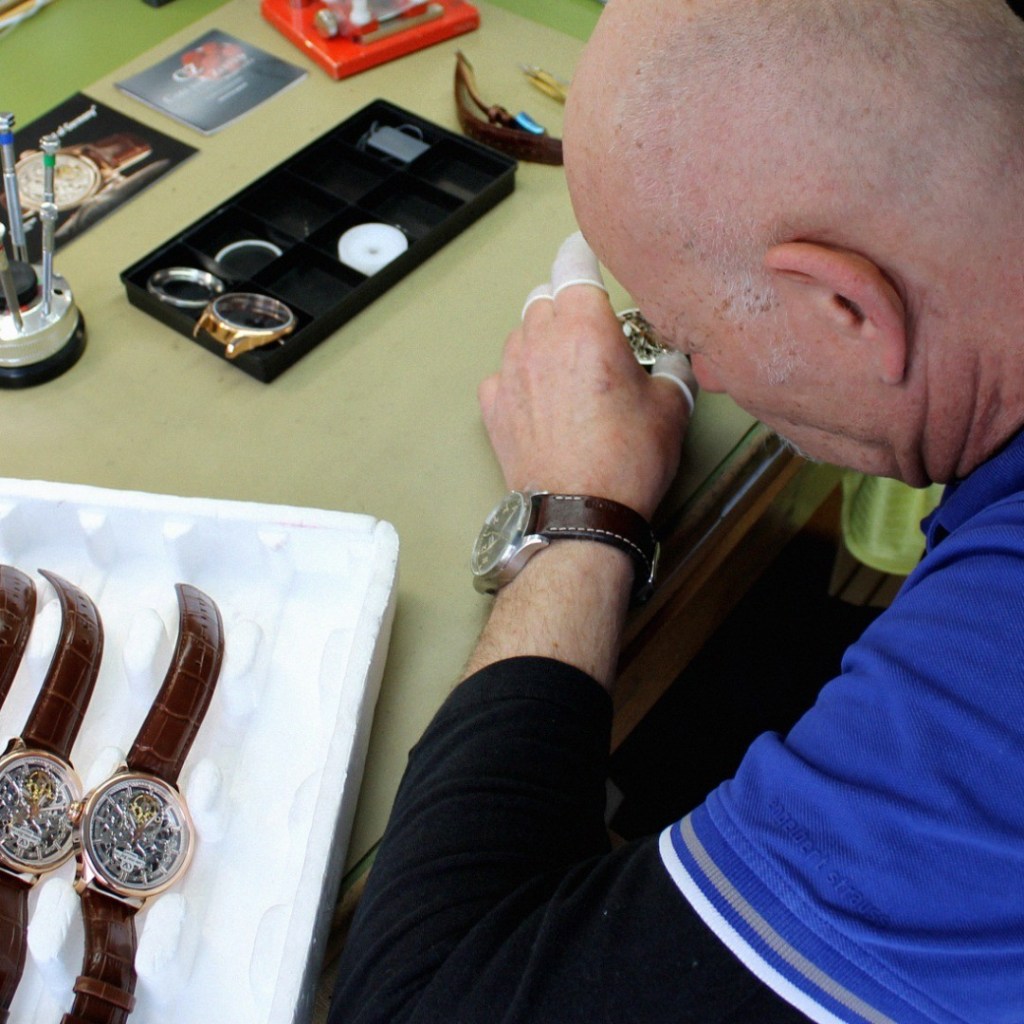
The majority of watch manufacturers advise servicing watches every two to five years. We disagree. Maintenance is expensive and should only be done if there is an essential aberration that cannot be corrected, such as when the watch runs incredibly slowly or quickly or when the power reserve drastically decreases. The movement will be cleaned, lubricated, and wear parts changed during maintenance operations. Some watches last for around 20 years without any maintenance. Manufacturers also advise using a jeweler’s shop to return the watch to them. Instead of taking it to a jeweler’s store, we advise asking a master watchmaker directly. They are far more advantageous at repairing the majority of timepieces.
Safe-keeping
If you don‘t want to use your watch for a considerable amount of time, you should keep it at a dry place that is sheltered from direct sunlight.
Water Resistance
This feature is considered at the time of the measurement if the watch passed a test for water resistance. In accordance with DIN 8310, gasket aging and attrition render water resistance a transient quality. A watchmaker must check the water resistance once again after dropping the watch, a concussion, or significant temperature changes, especially before water contact. A watch should have at least 3ATM of water resistance in order to be worn on the wrist while doing dishes or taking a shower (30m). The trouble with swimming isn’t the water; it’s the sudden change in pressure you experience when you plunge your arm into the water and the subsequent stroke you make against the water’s surface. Also, you must ensure that the watchcrown is removed or screwed.
 cvzwatch.com